Modelling opportunities for lake monitoring
Traditional environmental monitoring of lakes is based on in situ measurements and/or sampling, which provide data with relatively low uncertainties. However, such monitoring is generally spatially and temporally discontinuous, as a compromise has to be reached between cost and data requirements.
In this context, numerical models provide an opportunity to interpolate available in situ data, or even to calculate parameters retrospectively or prospectively. The ability to simulate variables over long periods is particularly important for detecting trends in time series. Indeed, in the context of climate change, we need to be able to discern trends from the inherent variability of time series. The models benefit from complementary data (in situ monitoring, satellite data) for their parameterisation and validation, and are therefore no substitute for any other form of monitoring.
Projets
1. Temperature modelling
Water temperature is an important parameter influencing the functioning of lake ecosystems by affecting the physical structure of the water column (the habiat in lakes), quatic organisms and therefore potentially the structure of food webs. Water temperature 's affected by air temperature and the weather in general(solar radiation, wind), and therefore responds directly to global warming.
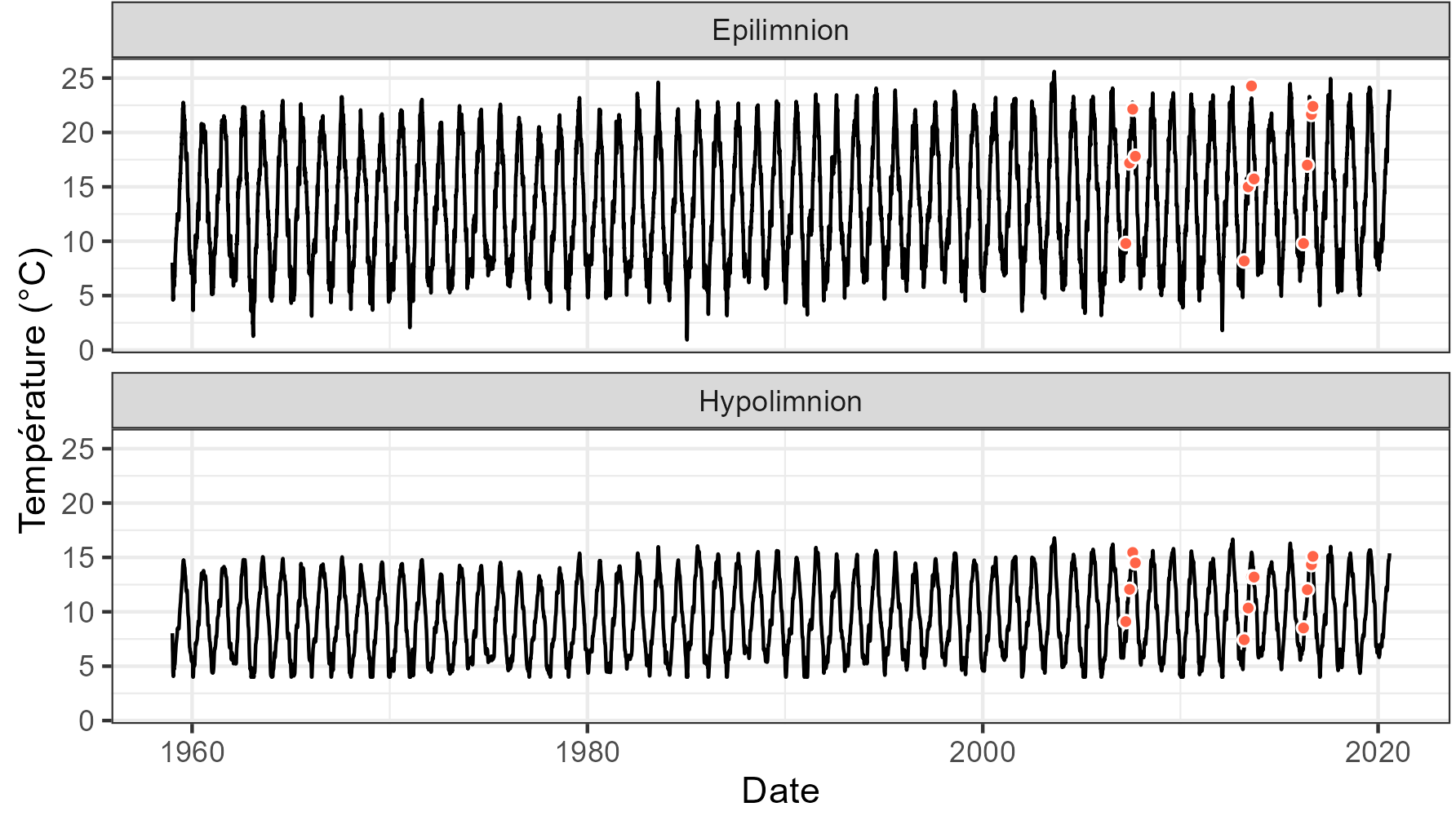
The aim of one of the ECLA cluster's projects is to model the temperature of 401 lakes monitored for the WFD (Water Framework Directive) in mainland France in order to quantify the effects of climate change on the temperature of these ecosystems. Modelling is carried out using the OKPLM model (Ottosson-Kettle-Prats Lake Model) developed within the ECLA Cluster (Prats & Danis, 2019), which provides daily output temperatures for the epilimnion and hypolimnion. For more information Visit the "Temperature modelling data" tab.
2. Other modelling projects
Within the ECLA cluster, several projects are underway, notably to model temperature on a finer scale in Lake Annecy, and also to model trophic links in some of the WFD lakes (from plankton to piscivores).